Is My Solitaire Game Winnable? Here's How to Know
You're deep into a game of Klondike Solitaire. You've been playing for 10 minutes, cycling through the stock pile, and nothing seems to work. You start wondering: is this game even winnable, or am I wasting my time?
It's one of the most common questions solitaire players ask — and the answer might surprise you. A significant percentage of Klondike Solitaire deals are mathematically impossible to win, regardless of how well you play. Here's everything you need to know about solitaire winnability, and how to check whether your specific game has a solution.
Play Solitaire with Winnable CheckerTable of Contents
- Not Every Solitaire Game Is Winnable
- What Percentage of Games Are Winnable?
- Why Some Games Are Impossible
- Warning Signs of an Unwinnable Game
- Can Your Moves Make a Game Unwinnable?
- How to Check If Your Game Is Winnable
- How to Always Start with a Winnable Game
- Draw 1 vs Draw 3: Winnability Compared
- Frequently Asked Questions
Not Every Solitaire Game Is Winnable
This is the most important thing to understand about Klondike Solitaire: the game is not always solvable. When you shuffle a standard 52-card deck and deal it into the Klondike layout, the random arrangement of cards can create situations where no sequence of legal moves leads to victory.
This isn't a flaw in the game — it's a fundamental aspect of what makes Klondike Solitaire interesting. Unlike FreeCell (where 99%+ of deals are winnable), Klondike's significant percentage of unwinnable deals means that recognizing when to give up and deal again is itself a skill.
The question is: how do you tell the difference between a game you can't win and a game you haven't figured out yet?
What Percentage of Klondike Games Are Winnable?
Researchers and computer scientists have spent decades studying Klondike solvability. While exact numbers are hard to pin down (the search space is enormous), extensive simulations give us reliable estimates:
Draw 1 (Turn 1)
Winnable with perfect play
~21% of deals are impossible
Draw 3 (Turn 3)
Winnable with perfect play
~70% of deals are impossible
Important distinction: these are theoretical win rates assuming perfect play — meaning the optimal move is made at every decision point. Human players win far fewer games because finding the optimal move sequence among thousands of possibilities is extremely challenging. Typical human win rates are:
- Beginner (Draw 1): 5-10% win rate
- Intermediate (Draw 1): 15-25% win rate
- Expert (Draw 1): 35-50% win rate
- Beginner (Draw 3): 1-3% win rate
- Expert (Draw 3): 8-15% win rate
The gap between the theoretical maximum and actual human performance shows that even when a game is winnable, finding the winning path is genuinely difficult. A solver can tell you the game is solvable, but you still need skill to actually win it.
Why Some Solitaire Games Are Impossible to Win
Unwinnable Klondike deals are caused by the random shuffle creating configurations where critical cards are permanently inaccessible. Here are the most common reasons a deal can't be won:
1. Buried Kings
Kings are the only cards that can fill empty tableau columns. If all four Kings are buried deep in the tableau with large numbers of face-down cards above them, it may be impossible to create the empty columns needed to reorganize the board. Without empty columns for temporary card storage, many moves become impossible.
2. Blocked Foundation Cards
Sometimes low-ranked cards (Aces, 2s, 3s) needed for the foundations are trapped under higher-ranked cards in the stock pile or tableau. If the only way to access these cards requires moving other cards that themselves have nowhere to go, the game reaches a deadlock.
3. Circular Dependencies
The most insidious unwinnable pattern is a circular dependency: card A can only be moved if card B is moved first, but card B can only be moved if card C is moved first, and card C can only be moved if card A is moved first. This creates an impossible loop that no sequence of moves can break.
4. Stock Pile Dead Ends (Draw 3)
In Draw 3 mode, only every third card in the stock pile is directly accessible during a given pass. If critical cards fall in positions that are never directly accessible (always covered by two other cards), they can become permanently trapped. This is the primary reason Draw 3 has a much lower winnability rate than Draw 1.
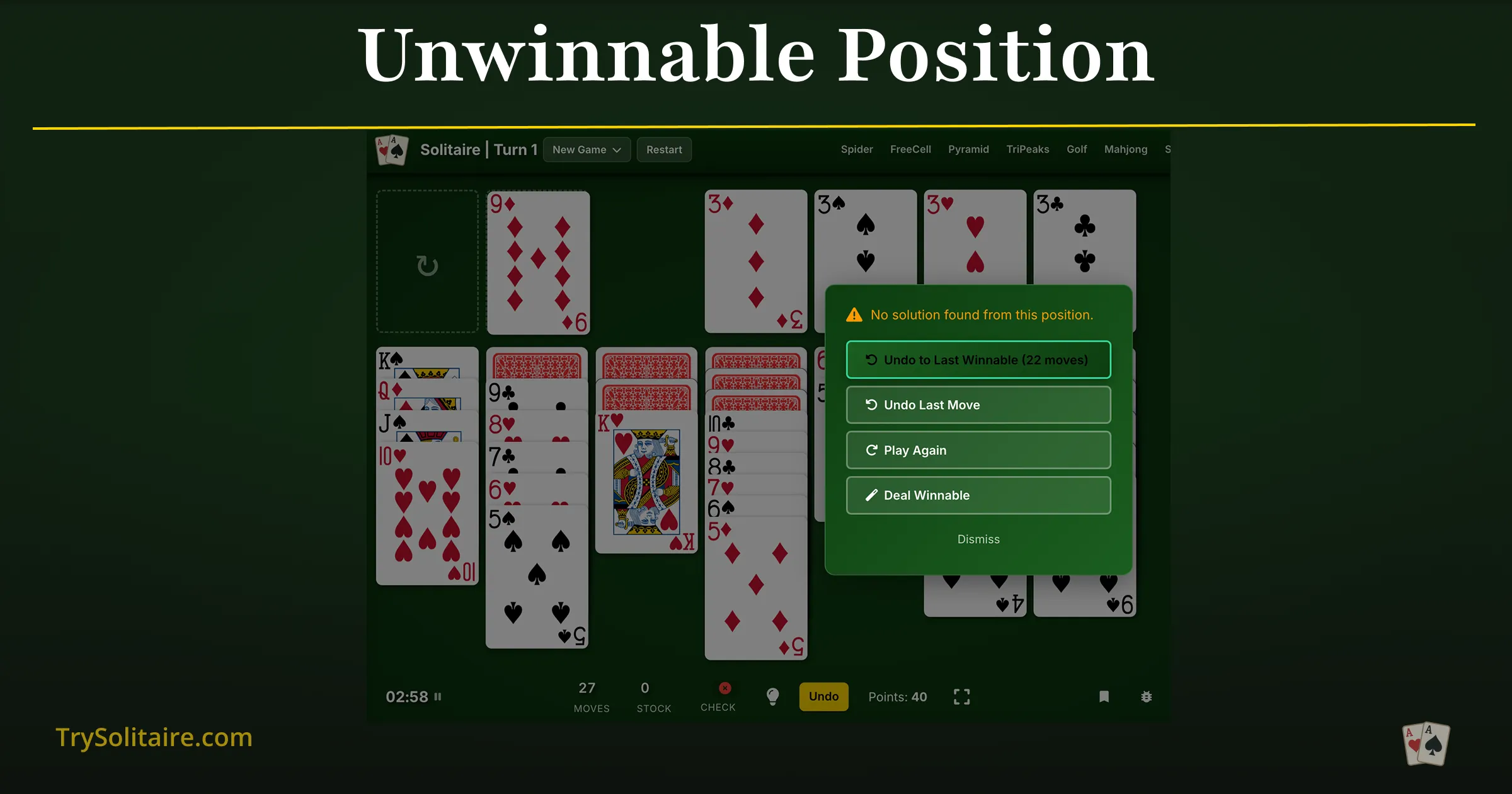
Warning Signs Your Game Might Be Unwinnable
While only a solver can definitively determine winnability, these warning signs suggest a game may be unwinnable:
Red Flags to Watch For
- Full stock cycle with no moves: You've gone through the entire stock pile without being able to play a single card. In Draw 1, this is a very strong indicator.
- All Kings buried: You've revealed significant portions of the tableau and no Kings have appeared, while you need empty columns to progress.
- Same cards keep appearing: In Draw 3, you keep seeing the same unusable cards on each cycle because the useful ones are trapped between them.
- Foundation gaps: One or more suits have their low cards (Ace, 2, 3) deeply buried while the foundations for other suits are progressing, creating an imbalance that blocks moves.
- No face-down cards accessible: All remaining face-down cards are trapped under long sequences that can't be moved without empty columns or specific cards you don't have.
However, these signs are not definitive proof. Some games that look hopeless can still be won with creative move sequences. The only way to know for certain is to use a solver.
Can Your Moves Make a Winnable Game Unwinnable?
Yes. This is a crucial point that many players don't realize: even if a deal starts with a winning path, your moves can close that path off and make the game unsolvable from your current position.
For example:
- Moving a card to a foundation when it's needed in the tableau for building sequences
- Placing a King in an empty column when a different King was needed there
- Building a long tableau sequence that buries a critical low card
- Drawing from the stock when a tableau move was the winning play
This is one of the most valuable aspects of TrySolitaire's built-in solver: it can detect when a move has made your game unsolvable and offer to undo back to the last winnable position. This "Undo to Winnable" feature lets you try a different approach without starting over.
How to Check If Your Game Is Winnable
TrySolitaire includes a free built-in solver that checks your game's solvability in real time. Here's how to use it:
Method 1: Check the Solver Icon
Look at the solver status icon in the game toolbar. It automatically updates as you play:
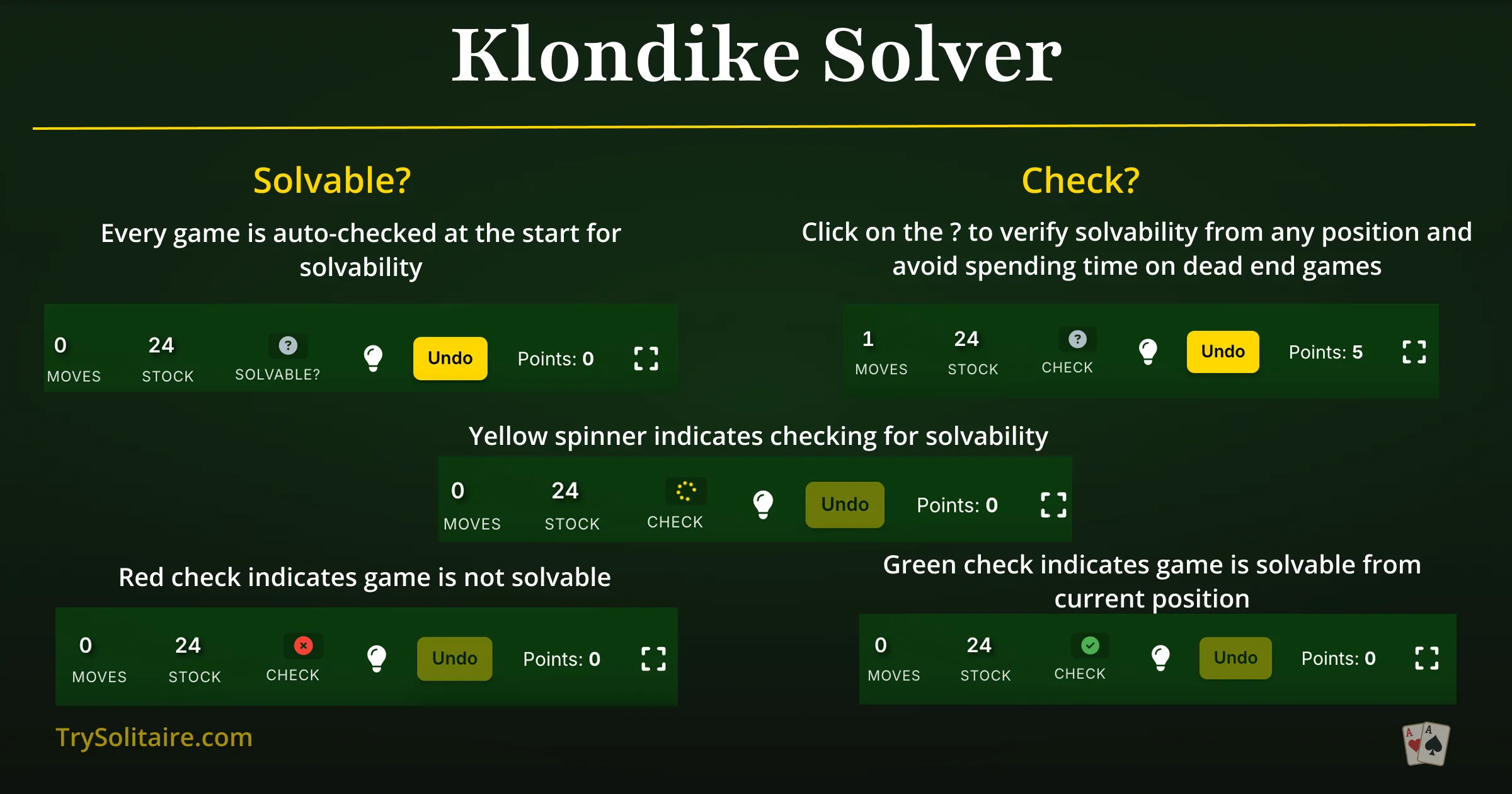
Solver Status Guide
- Green Checkmark — Your game IS winnable. A verified winning path exists from your current position.
- Red X — Your game is NOT winnable. No winning path exists. Click for recovery options.
- Gold Spinner — The solver is analyzing your position. Wait a few seconds.
- Gray Question Mark — Not yet checked. Click to trigger analysis.
Method 2: Click to Analyze
At any point during your game, click the solver icon to trigger a fresh analysis. The solver evaluates up to 10 million move combinations to determine whether a winning path exists from your exact current position — accounting for every move you've made.
Method 3: Watch for Automatic Detection
The solver also runs automatically in the background. When you start a new game, it immediately begins analyzing the deal. If at any point it detects that your game has become unsolvable (typically after a move that closed off the last winning path), a recovery panel appears offering to help.
How to Always Start with a Winnable Game
If you want to guarantee that every game you play is solvable, use the "Deal Winnable" feature:
- Click "New Game" or open the game menu
- Select "Deal Winnable" instead of the regular new game option
- The solver finds a deal with a verified winning path
- Play the deal knowing it can be won with the right moves
This is especially valuable for:
- Draw 3 players: Since 70% of Draw 3 deals are unwinnable, this feature saves enormous amounts of time
- Players learning strategy: Focus on improving your skills without the distraction of impossible games
- Limited play time: Make every game count when you only have a few minutes
- Competitive play: Ensure you're always comparing skill, not luck
Note: Deal Winnable Doesn't Make the Game Easy
A winnable deal means a solution exists — it doesn't mean the solution is obvious. You still need strategy, planning, and skill to find the winning move sequence. Many winnable deals have only one or two viable paths among thousands of possible move sequences. The solver guarantees the game can be won; winning it is still up to you.
Draw 1 vs Draw 3: How Draw Mode Affects Winnability
The draw mode you choose has a massive impact on how many games are winnable:
| Aspect | Draw 1 (Turn 1) | Draw 3 (Turn 3) |
|---|---|---|
| Deals Winnable | ~79% | ~30% |
| Deals Unwinnable | ~21% | ~70% |
| Human Win Rate (Expert) | 35-50% | 8-15% |
| Card Accessibility | Every card individually accessible | Only every 3rd card directly accessible |
| Solver Value | High (saves 21% wasted time) | Critical (saves 70% wasted time) |
| Deal Winnable Impact | Moderate improvement | Dramatic improvement |
The dramatic difference in winnability between Draw 1 and Draw 3 is caused by card accessibility. In Draw 1, you can reach every card in the stock pile one at a time. In Draw 3, you draw three cards but can only play the top one. The other two become temporarily inaccessible until you cycle through the entire stock and return to their position. This creates many more dead-end situations.
If you're frequently frustrated by unwinnable games, consider switching from Draw 3 to Draw 1, or use the "Deal Winnable" feature to guarantee solvable games in either mode.
Frequently Asked Questions
Is every game of solitaire winnable?
No. Approximately 21% of Klondike Draw 1 deals and 70% of Draw 3 deals are mathematically impossible to win. The random card shuffle creates configurations where critical cards are permanently blocked, making it impossible to complete all four foundations regardless of how perfectly you play.
How do I know if my current game can be won?
Use TrySolitaire's built-in solver. The solver icon in the toolbar shows a green checkmark if your game is winnable or a red X if it's unsolvable. Click the icon at any time to check your current position. The solver analyzes up to 10 million move combinations and typically returns a result within seconds.
Can I make a winnable game unwinnable?
Yes. Making wrong moves can close off the winning path and leave you in an unsolvable position. This is why TrySolitaire's "Undo to Winnable" feature is so valuable — when the solver detects you've reached an unsolvable state, it can automatically rewind to the last position where a winning path existed.
Why is Draw 3 so much harder than Draw 1?
In Draw 3 mode, you draw three cards from the stock but can only play the top one. This means two-thirds of stock cards are not directly accessible on any given pass. Critical cards often get trapped between unusable cards, creating permanent blockages. This reduces winnability from ~79% (Draw 1) to just ~30% (Draw 3).
How can I avoid unwinnable games?
Use the "Deal Winnable" option in TrySolitaire's new game menu. The solver verifies that the deal has at least one winning path before it's dealt to you. This works for both Draw 1 and Draw 3 modes, guaranteeing every game you start is solvable.
Does the solver reveal the solution?
No. The solver only tells you whether a winning path exists — it doesn't show you the moves. This preserves the challenge and satisfaction of finding the solution yourself. You still need strategy and skill to win.
Is the solver free?
Yes. The solver is completely free with no limitations, no ads, and no account required. It runs entirely in your browser — your game data never leaves your device. All solver features including solvability checking, Deal Winnable, and Undo to Winnable are included at no cost.
What about other solitaire variants — are they all winnable?
It varies dramatically by variant. FreeCell has 99%+ winnability, making almost every game solvable. Spider Solitaire (1-suit) is about 90% winnable. Pyramid is roughly 50%. Each variant has its own solvability profile based on its rules and mechanics. Currently, TrySolitaire's solver is available for Klondike Solitaire.
Check If Your Game Is Winnable
Play Klondike Solitaire with a built-in solver — never waste time on impossible games again.
Play Solitaire with Solver✓ Built-in solver | ✓ Deal winnable games | ✓ Undo to winnable | ✓ 100% free
Related Articles
- Solitaire Solver Guide — Complete guide to using TrySolitaire's built-in solver
- Klondike Solitaire — Full rules, strategy, and win rate analysis
- Klondike Strategy Guide — Expert tips to improve your win rate
- How to Win at Solitaire — Proven strategies for all solitaire variants